
NAVIGATION GENERAL PRINCIPLES
To avoid the risk of collision the following principles should be adhered to:
- Always keep a good lookout.
- Proceed at a safe speed according to conditions, visibility, traffic and location etc.
- Take early and obvious action when giving way
- Lights should be visible on all craft at night
- Vessels with right of way should hold a steady course and speed. If action becomes necessary, and when safe to do so, turn to starboard.
- Power driven vessels crossing: the one with the other vessel on its starboard side gives way.
- Vessels should not impede other vessels confined to a narrow channel.
- Power driven vessels approaching head-on: both turn to starboard.
- At no time should any craft be under the control of anyone under the influence of drugs, alcohol or any other mind altering substance.
In addition to this:
- All craft are asked to give assistance and aid, where required, to other craft in times of need.
- Craft capable and with adequate experience of towing should have a tow rope on board.
- All powered craft should carry a marine grade spill kit.
ALL VESSELS
Give way to:
- Vessels fishing. (Fishing vessels, especially those trolling, should display a trolling shape, that being a round orange coloured ball approximately 200mm in diameter, on a fixed pole or rod .75m long and positioned in an appropriate part of the fishing boat where it is clearly visible all around. No vessel should approach within 150m astern of a fishing boat engaged in trolling and displaying a trolling shape.)
- Vessels unable to manoeuvre
- Vessels restricted in their ability to manoeuvre
- Vessels constrained by their draught
- Any vessel they are overtaking
- Swimmers, bathers and paddlesports.
VESSELS UNDER POWER
Give way to:
- Vessels under sail
- Swimmers, bathers and paddlesports.
VESSELS UNDER SAIL
Give way to:
- Vessels sailing to their leeward (if on their port tack)
- Vessels sailing on starboard tack
- NB: looking forward, port is on the left and starboard right.
THIS SUMMARY IS NOT A SUBSTITUTE FOR A THOROUGH UNDERSTANDING OF THE MARITIME COLLISION REGULATIONS
GENERAL
Loch Tay is a very popular and well utilised body of water in the heart of Highland Perthshire. This code of conduct is for all loch users safety and to help ensure the tranquility and conservation of the loch is maintained.
Due to an increase in the number of different users, such as wild swimmers, paddleboarders, canoeists and kayakers, which are possibly the most vulnerable loch users, it has been deemed necessary to update the CoC to facilitate for that increase.
ALL loch users should be aware of all other users and remain alert, vigilant and respectful to their safety, needs and enjoyment of the loch.
All Loch users are responsible for taking adequate precautions for the safety of themselves and of others who may be affected by their activity. Although this Code provides some basic guidelines on safety it is no substitute for common sense, care, observation and awareness.
The loch can be dangerous as it is deep and subject to squalls. The shoreline is steep in many places and some sandy beaches which appear shallow and safe, shelve very steeply a short distance from the shore. The water level of the loch can change by as much as ten feet during the year, there are many rocks close inshore which, with the changing water level, are a hazard to navigation. They are unmarked. Being a large water mass fed by rivers bringing melted snow down from the mountains, the water temperature for much of the year is very cold.
It is strongly recommended that all loch users wear PPE appropriate to the activity in which they are engaging. It is recommended that all such PPE is Kite marked or CE approved.
It is also recommended that they ensure they are wearing appropriate clothing, taking into consideration weather and loch conditions and that these conditions can change very quickly.
It is also strongly recommended that ALL users have a plan for emergency situations and where appropriate, have left a route plan and time of return with a responsible person on shore.
EMERGENCY SERVICES
There are no rescue patrols on the loch.
In the event of an accident or other emergency, the normal emergency services should be called immediately on 999 or 112 from the nearest telephone which is most likely to be the nearest house.
BOATS
Bio-Security.
- Blue green algae has been apparent on the loch, particularly during long dry spells and lower water levels.
- Loch users should be aware that this algae can cause illness to humans and can be harmful to dogs.
- It is recommended to not participate in watersports or dog swimming where this algae is present.
- All users of the loch should take care to ensure that they are not bringing contaminants – chemical or biological – from other freshwater areas. Good bio-security practice is to ensure that boats hulls, canoes, paddleboards, skis, paddles, rowing boats and oars, wetsuits and swimming costumes and floats are washed with clean water between immersion in different bodies of water.
Access to Loch Tay – Non powered craft
- Under the Scottish Outdoor Access Code you can carry non-powered craft, such as canoes, surfboards and dinghies to Loch Tay for responsible recreation. That access code does not permit you to take a vehicle (with or without a trailer) across land to get to the water.
Access to Loch Tay – Powered craft
- If you are planning to take your powered craft (any craft with an engine) across land to Loch Tay or tributaries you must first obtain the express permission of the landowner.
INSURANCE
- All boat users should be covered by a third party public liability insurance. The consequences of any mishap can be drastic and very expensive.
USE OF LOCH TAY
- The aim of these guidelines, issued by the Loch Tay Association, is to provide a code of conduct for the loch so that all users
may enjoy the pursuit of their choice without
undue interference and in safety.
WILD SWIMMING
- Wild swimming has become increasingly popular on Loch Tay in recent years and has increased the necessity for a higher degree of awareness and consideration from all parties using the loch, in particular wild swimmers themselves and all powered boats.
- All power boats are to ensure they adhere to the 4 knot speed limit within 150 meters of the shore and recreational towing should not take place east of the line between Dalerb (Crannog Centre), on the north shore and the fish farm, on the south shore.
- All powerboat drivers should remain vigilant in observing for wild swimmers, who generally will be wearing a brightly coloured swimming cap or towing a high visibility flotation device or buoy. They must also be aware that not every wild swimmer might wear such, so vigilant observation is necessary.
Wild swimmers should wear either a brightly coloured swimming cap, a high visibility device such as flotation device or buoy, or both. - It is recommended that wild swimmers access the loch in the quieter areas of the loch, avoiding areas where there is increased use by powerboats and other watercraft.
- All powered craft are to adhere to the 4 knot speed limit within 150 meters of wild swimmers.
FISHING
Salmon
- Fishing is strictly controlled on the loch and its tributaries. For salmon fishing the loch is divided into three sections, east, central and west. Salmon fishing is limited to those with a legal permission known as a ‘Right’ to fish in a specific area. It is a criminal offence to fish for salmon without a salmon right or the permission of the owner of that right.
- Those salmon fishing are strongly advised to have the written authority of the ’Right’ owner so that they may show it to the water bailiff. Salmon ‘Rights’ are allocated a number and this must be clearly displayed on boats. Salmon fishing is forbidden on Sundays by statute.
- When trolling, ie towing a fishing line behind a boat, it is advised that a ‘trolling shape’ should be displayed, being a round orange coloured ball approximately 200mm in diameter, on a fixed pole or rod .75m long and positioned in an appropriate part of the fishing boat where it is clearly visible all around. No vessel should approach within 150m astern of a fishing boat engaged in trolling and displaying a trolling shape.
Trout
- Trout fishing is subject to the River Tay Protection Order and a written permit for either bank or boat fishing must be obtained in advance. Fishermen are required to comply with the regulations shown on the permit which includes information on the area covered by the permit.
Bank fishing permits may be obtained from local angling clubs.
Permission to fish for trout from a boat can be obtained from
Pitlochry Angling Club
https://www.beatbooker.com/bbpaconline
PADDLESPORTS
- It is strongly recommended that all paddlesports participants ensure they are wearing the correct PPE and clothing for their activity, always giving consideration to the current weather patterns and loch conditions. It is recommended that all PFDs, buoyancy aids and life jackets are either CE approved or Kite marked and are regularly checked for being fit for purpose.
Emergency equipment such as survival blanket, mobile phone, route plan and estimated return time should all be considered, especially on longer expeditions. - Paddlers should be particularly aware around marinas, moorings and other busier areas of the loch.
- Paddlers should consider the distance they venture from the safety of the shore should be governed by their own personal competence in their chosen activity.
RECREATIONAL TOWING
- Recreational towing should not take place east of the line between Dalerb (Crannog Centre) on the north shore and the fish farm on the south shore.
Increased awareness and vigilance should be observed in all areas around the loch that have a higher volume of access takers and loch users, such as Marinas, public access areas and private moorings. - Recreational towing should also not take place in any of the designated speed limit and restricted zones.
- Boats towing skiers, boards, ringos and the like should carry an observer in addition to the driver to relay information and to assist in any way ensuring the safety of the skier, and be fitted with a driving mirror so that the driver can see the skier and other boats behind.
- The boat should have an adequate alternative means of propulsion (auxiliary engine, paddles or oars) to enable it to pick up a fallen water skier in the event of an engine failure.
BATHING
- Bathing is dangerous except in shallow water, even here a bather can quickly be out of their depth if they step over a hidden shelf. The water is likely to be very cold and could cause cramp, exhaustion or hypothermia very quickly. Safety aids where appropriate should be worn.
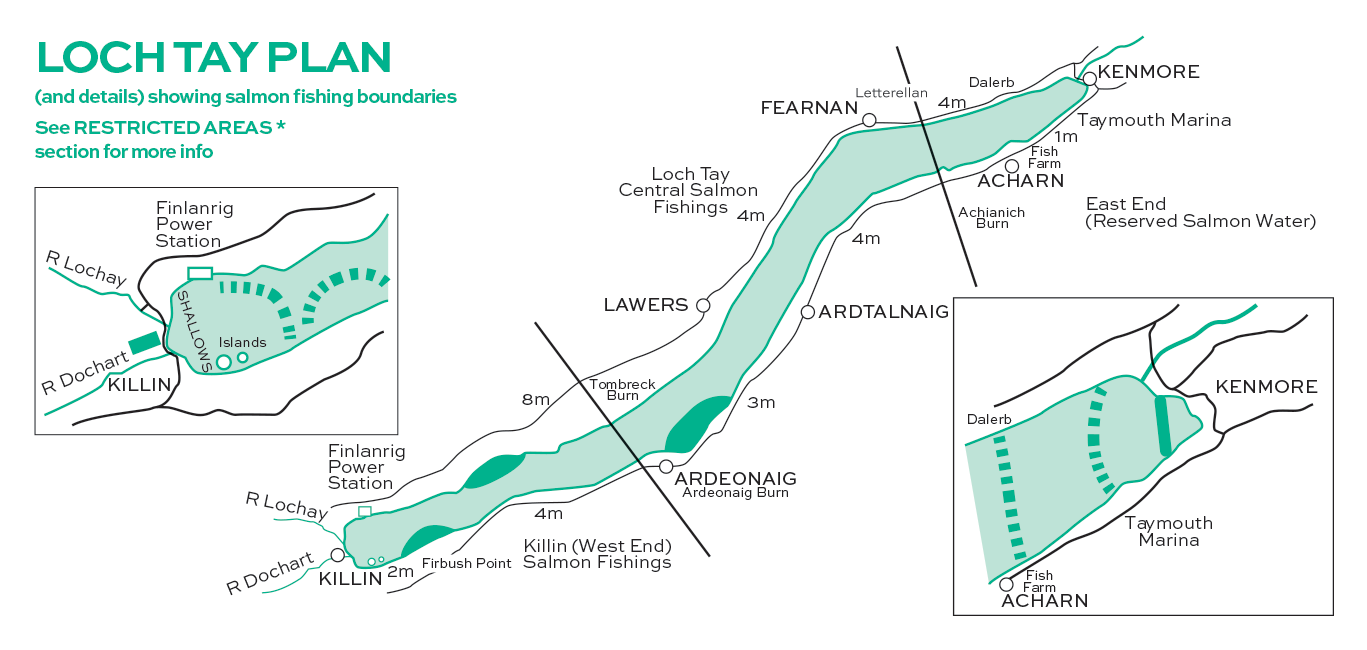
RESTRICTED AREAS * – See Map Below
- East end: Powered boats should stay away from the beach area marked on the plan by the solid red line or beyond the bridge over the River Tay. Participants engaging in recreational towing should avoid the area to the east of the line being a projection between the posts on the Dalerb (Crannog Centre) on the north and the fish farm on the south.
- West end: Motor boats of all type should be aware of the sandbar at the west end of the loch, closer to Killin. This sandbar shifts on an annual basis with the fluctuating levels of the loch and a speed limit of 4mph should be adhered to in the area marked on the map. There are also a number of large trees, both visible and submerged, which could be extremely hazardous to motor boats. It is recommended that boat operators who are not familiar with this area and these hazards, do not attempt to travel west of the line marked on the map.
Again, for reasons of safety, a speed limit of 4mph is to be maintained inside areas where boats are moored (marked on the plan in BLUE) and on the Rivers Lochay and Dochart. - Power boats should keep a minimum distance of 150 meters away from the shore swimmers, paddlecraft, sailing and fishing boats, observing a speed limit of 4mph within that distance, with the exception of an emergency situation.
- Remember that many paddlecraft participants are novices and under instruction and the close wake from a powerboat can be very distressing for them, as it can for wild swimmers and bathers.
Powerboats should also stay a minimum distance of 250 meters away from residential properties, to prevent disturbance to local residents.
SPEED LIMIT
- All powered boats and jetski’s should not exceed 4mph within 150 metres of loch shore or island shores – and comply with the speed limits for all restricted areas such as marinas, private moorings and areas for public access.
- Caution is required where there is a lot of sailing, windsurfing, paddlesports and swimming activity.
- Power boats should reduce speed or avoid going near other loch users. Remember that many watersports participants are novices and under instruction. Always be on the lookout for swimmers and bathers and reduce speed accordingly.
YOUNG PERSONS
- No power-driven boat of greater engine power than 5hp (3 kilowatts) should be under the command of a person under the age of 16 years.
NOISE AND SILENCERS
- All outboard engines or engines installed in personal water craft (PWCs) should be efficiently silenced. No person should operate a craft on the loch in such a manner or for such a time as to give any other person reasonable cause for annoyance. It is requested that power boat and PWC users do not use the loch before 9.00am and after 9.00pm.
- Boat owners should be aware that all noise whether engine, voice or music system, carries further on water, particularly at night.
LITTER
- Please take your litter home with you and keep Lochtayside a litter free area.
- Take nothing but photos, leave nothing but footprints.
THE LOCH TAY ASSOCIATION CAN BE CONTACTED THROUGH ITS SECRETARIAT ON: lochtayassociation@gmail.com
DISCLAIMER
- The Loch Tay Association does not accept any responsibility
for Inaccuracies or omissions or for any accident or incident however caused, allegedly arising directly or indirectly from
this Code.